
Revised and Expanded Strength Standards

It’s time to do an update on the baseline (aka “minimum”) strength standards we proposed several years ago, here:
What are we revising?
While the powerlifting lifts remain the most objective measurement of 1RM strength, they are limited to only 3 lifts. We also know that strength can be expressed across all movements the human body can do, most of which would not be compelling 1RM events in sport. We also know that some movements and muscle groups are just not well suited to 1RM training and testing, and will be better served if trained for hypertrophy or task specific conditioning. Finally, not everybody wants to train like a powerlifter, and thus we need some equivalencies for people to train in other methods.
In this effort, we cannot possibly provide exact equivalencies across all modes and methods of training. The scope of this article is to simply provide and update and expansion of the previous work. Thus we will not be going over all of that same material as in the previous article again.
To recap the previous article, we estimated an approximate 2x body weight for squat and deadlift, and 1x body weight for bench press. We are going to expand this out, and refine those calculations a bit.
Keep in mind, these are baseline, or minimum standards, and you should honestly strive to be as strong as you can be without it negatively impacting your martial arts training.
Establishing Metrics
Humans are not uniformly strong. Genetic limits, including sex differences, exist. Excluding disability and disease, some people are still just going to be stronger than others, and a trained person is typically going to be stronger than an untrained person, even in spite of those differences in potential (but not always!)
Inter-individual differences are wide, and statistics generally only give us averages and spreads, so where you end up is going to be specific to you. You might find yourself in the middle, or on the edge somewhere, our completely outside the distribution. However, averages being what they are, the further toward the margins you go, the fewer people there will be.
All this means that these are not hard numbers, they’re squishy. And some of our equivalencies are based on estimates, which are even squishier. So please use this as a starting point that you can modify to your needs, as it is impossible for it to be absolute.
We start with the world records for [raw, drug tested] powerlifting and we should factor in non-linear scaling. Wilks and the superior GoodLift and DOTS formulas for comparing absolutes across variables are quite complicated, and you can use an online calculator for any of them, but since we’re ballparking here anyway, that’s not necessary. Humans roughly follow an allometric curve, which is to say, for our purposes, strength only increases about 2/3 of the rate of size, which is important to note when using body weight percentage (and weight class measured) metrics. Smaller people will have a higher relative strength, while larger people will have a higher absolute strength. This is why in the 114 weight class, the fully tested deadlift record is 4.25x body weight (485#) and the 308 weight class record is 2.87x body weight (882.9#), a nearly 1.5x difference. Of course, the allometric scaling formula takes a little doing too, so we’re going to give our premium subscribers a cheat sheet at the end.
For now, let’s reassess those early standards for the big 3. We know we want to be able to handle someone in our own weight class relatively well, which means bodyweight for reps on squat and deadlift (because you’ll need wrestling capacity, which sometimes means lifting an opponent from the ground, or onto your shoulders) and at least bodyweight bench so you can pop someone off of you if necessary. And we define “for reps” in the colloquial weight room terms, meaning hypertrophy rep range or greater, or 5-30 reps and beyond. So how does that measure up to our 1RM? There was a recent study comparing reps to %1RM
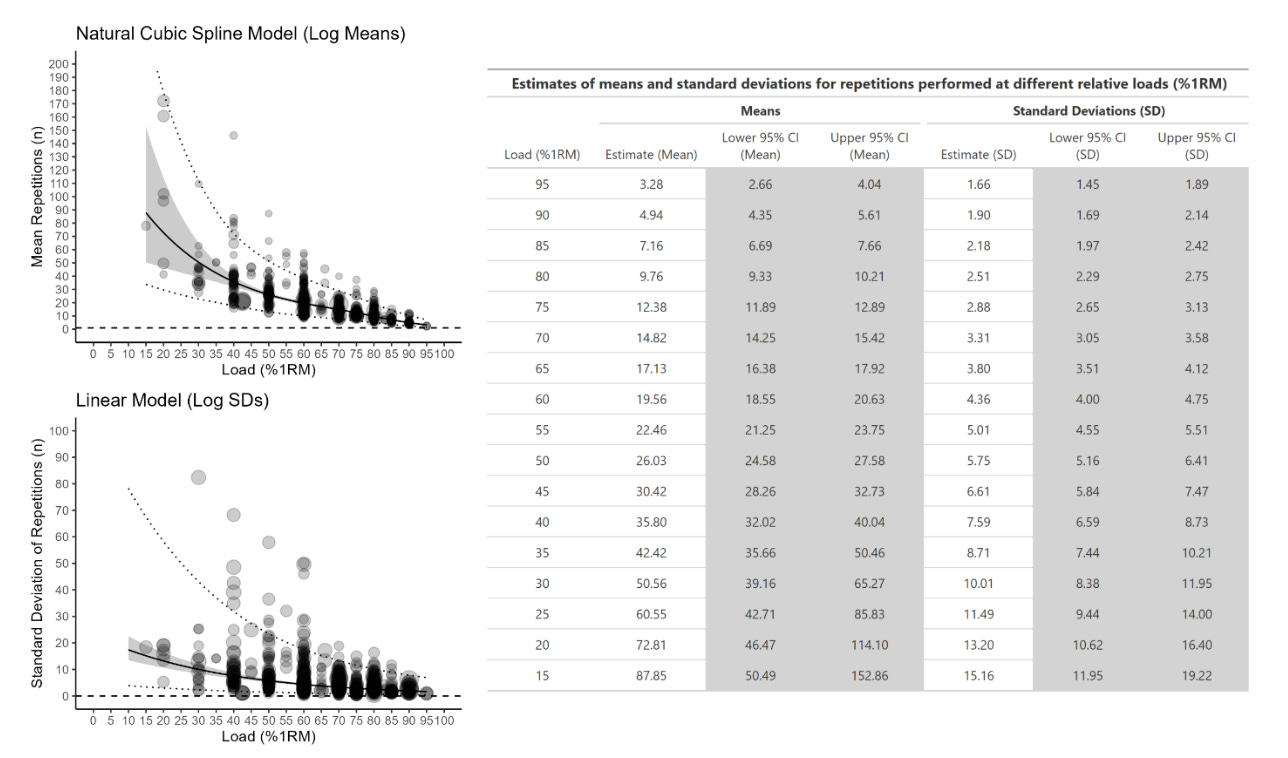
and on the low end, you’ll be looking at just under 90% of your 1RM for 5s, and obviously a shrinking percentage with more reps. But as someone who does 90%+ singles regularly, and as someone who’s fought, that might not be enough margin. You’ll fatigue throughout the action, and will still need that capacity late in the fight if it goes long. Well, we’ve another study demonstrating no increase in performance absent a general warmup at about 80% 1RM, and while going in cold is not the same as fatigued, it does suggest 10 reps might be a better metric than 5 for us. Also, the further away from 1RM we get, the wider the spread between individuals, and it seems like we hit the point of that widening spread somewhere between 40 and 50%. Now, you want to be stronger, rather than weaker, so our original estimate of 2x body weight for the two lower body lifts isn’t bad, and I think a bodyweight bench is perfectly reasonable. But the above could take us to just 1.25x bodyweight. That’s really achievable, but honestly still sounds kinda weak to me. Why don’t we do this: An average between the above and 50% of the world record. 50% of the record is a little over our old estimates, and the 10RM idea is quite short of them. An average should get us strong, but still in the realm of training feasibility for serious martial artists, and will also help us account for scaling.
If we’re going by weight class, our center point is 180 lbs. for men. So then we go to powerlifting records, we find the nearest weight class, which is 181 lbs, and we find the records: 722 Squat (~4x BW), 547.8 (~3x BW) Bench, and 837.7 (~4.6x BW) Deadlift. Cut those in half for us: ~2x BW Squat, ~1.5x BW Bench, and 2.3x BW Deadlift. Then we average ([value 1 + value 2] divided by 2) with our 1x bench and 1.25x squat and dead for:
1.625x BW Squat (1.6x rounded)
1.25x BW Bench
1.775x BW Deadlift (1.8x rounded)
This gives us a really compelling set of the big 3 that will give us reps in the tank even up a weight class or two, which is really good. That being said, getting as strong as you can without significantly negatively impacting your ability to train martial arts is even better. Stronger is always better within those margins, and these numbers are just minimums.
Expanded exercise list
Now that we have adjusted our initial targets, we want to expand this list to give us some other reasonable targets and/or options. There are competing ideas out there, so, again, these are just rough targets to get you started.
First we need to fill out the barbells. A common Olympic Weightlifting practice is to be able to front squat 85% of your back squat. Benching is not the only pressing movement, and the overhead press (OHP) is a fantastic exercise. That used to be a competitive lift in the Olympics, and we can simply ratio that record to the bench record (by weight class, of course) for about 85% of bench. And, of course, if you want to do incline bench (like I do), a well trained estimate is around 90% of your flat bench.
“Equivalencies” are dependent upon training.
If you have not trained an exercise, you will not likely hit these numbers.
These are goals to train toward, and eventually surpass.
We also need a bent arm pull, and barbell rows are a great option: a general rule of thumb that trainers like is you should be able to row what you bench, so a simple equivalence, or 1.25x BW is a good option there. We don’t really need other “test” lifts for barbells, but you should absolutely be hitting your whole body in your program, especially shoring up lagging muscles with your assistance work.
What about dumbbells? Because they’re less stable than barbells (and typically don’t go as heavy), you won’t be able to lift as much, unless you do unilateral work, which, because of the bilateral deficit, will allow you to lift around 60% of what you would be doing with a barbell (That’s a training heuristic, and the deficit is fairly variable, and possibly plastic). A common estimate for bench press is that dumbbell bench should be around 80% of your barbell bench. Keep in mind, if the movement is unstable, your body will not be able to produce as much force, and some unilateral movements will take some time in training to develop some stability. So two dumbbells, probably a bit less weight, and one dumbbell, possibly a bit over half the weight. With cables it should be similar to dumbbells, with fixed path machines, stability is mostly taken out of the equation, and you’d expect an increase weight simply due to that increased stability. I don’t have numbers for stability changes. Except for leg press.
A lot of people don’t want to squat, for whatever reason, but are happy to leg press. Stronger By Science’s Greg Nuckols once wrote that if you assume a typical 45° leg press machine, you should probably be able to squat 70% of what you leg press. So if we’re aiming for a 1.6x BW squat at 180 lbs., then we should probably be looking a ~2.3x BW Leg Press.
A lot of people really like calisthenics (body weight exercise), and if we’re talking in multiples of bodyweight for load, that means we’re going to be talking about reps for the static load of our bodies. Of course, you can load calisthenics, but let’s just stick with raw calisthenics for now.
There are a couple of considerations we need to take into account. One is whether we’re doing bilateral or unilateral work. The other is how much of our weight are we actually moving? Body segment values are going to be pretty individual, but we do actually have normative data to help us start. For our squat alternatives, we have air squats at 77.05% BW, single leg squats at 88.3% BW, and split squats at about 85% BW. For bench we have push-ups at 64%, decline pushups around 70-74% BW depending on how high your feet are (12”-24” elevation), 1-Arm pushups at 68% BW, and hanging dips at about 90% BW. For Deadlifts, we have back extensions (aka “hyperextensions”) at a pitiful ~38% of bodyweight (it’s something, but it’s really not enough. ‘Needs load. We’ll come back to deadlifts later.)
But we can’t stop there, because those body segments are contributing to the load of our barbell metrics too, which means that all those percentages are an even lower percentage of our goals. so we need to adjust our goals to be total load, not just external load. For our 180 lb. example:
1.6x BW squat + .77x BW air squat load = 2.37xBW total load
1.25x BW bench/row + .10x BW arm segment load = 1.35xBW total load
.9x BW OHP + .10x BW arm segment load = 1xBW total load
1.8x BW dead + .59x BW upper body segment (or .77x BW if you have more of a squat style DL) = 2.39xBW (or 2.57xBW) total load
Then we have to ratio those percentages to figure out the percent of the percent we’re looking at. Or, to rephrase, our goal numbers point to 1RM test goals, and these bodyweight alternatives are going to be sub-maximal percentages which will have to be done for reps. By knowing the percentage of our goal 1RM, we can find goal reps. Thus our final formulas (for our 180 lbs example):
BARBELL BACK SQUAT (average of 1.25xBW and 1/2 of world record by weight class)
Barbell Front Squat = (roughly 85% of your back squat)
Air Squats = 32% of goal or nearly 50 reps (variance 39-65)
Split Squats = 36% of goal or ~25 reps (adjusted for unilateral 60%)
Single Leg Squats = 37% of goal or ~24 reps (adjusted for unilateral 60%)
45° Leg Press = (roughly 133% of your back squat)
———————FLAT BENCH PRESS (average of 1xBW and 1/2 of world record by weight class)
Incline Bench Press = (roughly 90% of your flat bench)
Push-ups = 47% of goal or ~28 reps
24” Decline Push-ups = 55% of goal or ~23 reps
1-Arm Push-ups = 50% of goal or ~16 reps (adjusted for unilateral 60%)
Dips = 67% of goal or ~16 reps
———————DEADLIFT (average of 1.25xBW and 1/2 of world record by weight class)
Power Cleans = (roughly equivalent to bench press)
Back Extensions = 16% of goal or somewhere between 50 and 150 reps…
———————BARBELL ROW (roughly equivalent to bench press)
Inverted Bodyweight-Rows = 47% of goal or ~28 reps
———————OVERHEAD PRESS (about 85% of bench press)
Hand Stand Pushups = 90% of goal or ~5 reps
Here’s the deal, loading schemes below around 80% of 1RM don’t predictably increase 1RM strength because of the skill component of 1RM lifting. However, general strength and conditioning will increase under these lower loading schemes. Keep in mind, there is a point of diminishing returns on hypertrophy at really low percentages of 1RM, which essentially means the effort you have to put in outweighs the benefit. But somewhere in the ballpark of 5-30 reps in at- or near-failure sets are roughly equivalent for hypertrophy. But we’re talking about strength, and the closer you are to the weight you expect to move, the better you’ll be able to move that weight.
But what about deadlifts?
Deadlifts are nearly irreplaceable. You can do loaded back extensions for your spinal erectors, which are by far the hardest muscles to hit with bodyweight movements. For your glutes and hams, hip thrusts and reverse hypers are fine. But the closest alternative to deadlifts is good-mornings. You can do banded good mornings with resistance bands if you don’t have a barbell. You can do one leg or kickstand deadlifts with dumbbells if you must. But a heavy load in your hands or on your back is damned near necessary to sufficiently strengthen your spinal erectors. If you wanted to do everything else bodyweight, I still have to recommend deadlifts. And you can do conventional, or sumo, or hex-bar, or RDLs and SLDLs, or even sand bag/stone lifts, but you need to be able to pick up heavy things off the ground. Again, the only real alternative being good-mornings, which will necessarily be lighter, but at least something you can work up to around bodyweight loads and beyond. You could also work power cleans (or full squat cleans if you have the skill) but they too will be lighter, which using our world record formula, will put you in the same ballpark as bench press.
You missed pull-ups and other conditioning exercises…
Nope, just saving them for last. These things are far less objective in comparison to our already squishy numbers.
Pull-ups don’t correlate well to rows. You are moving about 90% of your bodyweight, but without an analogous lift, it’s hard to put an objective number to it. I would love to say, “Just match it to your dips the way we match up rows to bench,” but pullups are always weaker than rows, and dips are actually stronger than bench proportionally. Maybe you could match them up to handstand push-ups, and that feels more accurate, but honestly, you should be able to do more pull-ups than handstand pushups. We just don’t have a clean number here. But maybe we split the two, and set a goal for somewhere in the ballpark between HSP and dips, which for our example of 180 lbs. would be between 5 and 16 reps. Funny enough, that is pretty close to most of the military passing standards for pull-ups (with the exception of a couple of special units. Though all of their 100% scores are higher.) So I’m comfortable with that as a standard. If you wanted to use military standards, you can always look them up online for the most up to date numbers.
When it comes to other conditioning exercises, you can dig around for things like the other military physical fitness standards, which are very easy to find online, or other sports standards, particularly football standards like you can find from the NFL combine or some university reports. I do have some preliminary data there, but I’ll save that for another time.
OK, time to wrap this up. If you want the cheat sheet below, you’ll need to become a premium subscriber, otherwise, happy math!
